
Get Support
123-456-789-10
Warehouse and Hangar Construction in Saudi Arabia
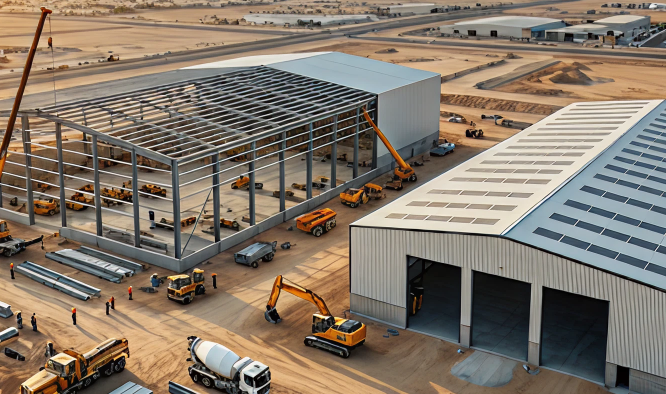
Warehouse and hangar construction in Saudi Arabia is one of the most important project types needed by commercial, industrial, and logistics sectors, especially with the expansion of economic activities and the increasing demand for safe and organized storage and operational spaces. Warehouses and hangars are not used only for storing goods; they can also serve as distribution centers, workshops, light manufacturing spaces, material storage facilities, or areas dedicated to logistics services.
The success of a warehouse or hangar construction project depends on proper planning from the beginning, choosing the right design, studying the nature of use, defining the required spaces, and executing the steel or concrete structure in a safe and practical way. Insulation, ventilation, lighting, entrances, safety systems, and ease of movement inside the site should also be considered so the project becomes suitable for daily operation and ready for future expansion.
Main Topics in This Article
- The importance of warehouses and hangars for commercial and industrial activities
- Defining the purpose of the warehouse before starting the design
- Choosing the right location for warehouse and hangar construction
- The right structural design according to the nature of use
- The difference between steel hangars and concrete warehouses
- Preparing the land and foundations before installing the hangar
- Thermal and waterproof insulation and their role in protecting the warehouse
- Ventilation and lighting systems inside warehouses and hangars
- Loading and unloading entrances and organizing vehicle movement
- Safety and protection requirements inside warehouses
- Factors that affect the cost of warehouse and hangar construction in Saudi Arabia
- How to choose the right warehouse and hangar contractor?
1- The importance of warehouses and hangars for commercial and industrial activities
Warehouses and hangars play a key role in supporting commercial and industrial activities because they provide a safe and organized space for storing products, raw materials, and equipment. They also help improve operational efficiency, organize inventory, facilitate shipping and distribution operations, and reduce clutter within work sites.
In Saudi Arabia, the need for warehouse and hangar construction is increasing with the growth of e-commerce, industry, contracting, logistics services, and investment projects. Therefore, building a properly designed warehouse gives the business greater ability to expand and operate efficiently.
- Organized storage: protecting goods and equipment from damage.
- Better operation: through easier movement and access to materials.
- Supporting expansion: by providing a space that can be developed in the future.
- Improving efficiency: in loading, distribution, and management operations.
2- Defining the purpose of the warehouse before starting the design
Before starting the construction of a warehouse or hangar, the main purpose of the project must be clearly defined. Will it be used for storing goods? As a distribution center? As an operational workshop? Or for storing heavy equipment? Each use requires a different design in terms of area, height, flooring, entrances, ventilation, and safety systems.
Defining the use from the beginning helps choose the right structural solution, distribute spaces practically, and avoid costly modifications after execution. It also helps determine the type of insulation, floor thickness, loading areas, and movement routes inside and outside the warehouse.
- Storage warehouse: requires internal organization and clear movement routes.
- Distribution center: requires efficient loading and unloading entrances.
- Operational workshop: requires proper ventilation and suitable electrical preparation.
- Equipment storage: requires strong flooring and suitable heights.
3- Choosing the right location for warehouse and hangar construction
Choosing the right location is one of the most important factors in the success of warehouse and hangar construction projects because the location affects accessibility, transportation cost, truck movement, proximity to customers or suppliers, and how suitable the land is for the intended use. A good warehouse is not only about the building itself, but also about how easy it is to operate every day.
Surrounding roads, land area, future expansion potential, availability of services, and the suitability of the location for industrial or commercial activities should all be studied. It is also important to ensure that the location allows the movement of large vehicles and provides loading and unloading areas without congestion or operational difficulty.
- Proximity to main roads and distribution areas.
- Providing enough space for truck and vehicle movement.
- Possibility of future expansion as the business grows.
- Availability of basic services such as electricity, water, and drainage.
- Suitability of the location for the required activity.
4- The right structural design according to the nature of use
The structural design of warehouses and hangars must suit the nature of use because a light-material warehouse is different from a heavy-equipment warehouse, and a food storage facility is different from an operational workshop or distribution center. Loads, heights, openings, columns, and the type of structure should be defined before execution.
A good design considers structural safety, ease of movement, the possibility of installing racks or equipment, resistance to weather conditions, and flexibility for future expansion or modification. It also helps reduce material waste and achieve the best use of the available space.
Important note: An unsuitable structural design may lead to operational problems, weak load capacity, or difficulty in future expansion. That is why it should be carefully studied before construction begins.
5- The difference between steel hangars and concrete warehouses
Steel hangars are a common choice in warehouse construction because they are fast to execute, flexible in design, and suitable for large spaces with wide spans. They can also be modified or expanded relatively easily, making them suitable for industrial activities, commercial uses, and storage centers.
Concrete warehouses, on the other hand, may be suitable for projects that require higher insulation, specific structural durability, or a fixed long-term design. Choosing between steel and concrete depends on the budget, nature of use, execution duration, safety requirements, and project size.
Steel hangars
Suitable for large spaces and fast execution, offering good flexibility for expansion and modification when needed.
Concrete warehouses
Suitable for projects that require a fixed structure, high durability, and certain insulation or operational requirements.
6- Preparing the land and foundations before installing the hangar
Land and foundation preparation is one of the essential stages in warehouse and hangar construction because the strength of the building starts from the base it is built on. This includes soil study, site leveling, defining levels, executing foundations, and preparing flooring according to the expected loads and intended use.
If the warehouse is intended for storing heavy equipment or goods, strong floors must be executed to withstand continuous movement, forklifts, and vehicles. Water drainage should also be considered to prevent water accumulation around the foundations or inside the storage area.
- Studying the soil before executing foundations.
- Leveling the land and setting levels accurately.
- Executing foundations suitable for the structure type and loads.
- Preparing floors that can withstand daily use.
- Considering water drainage inside and outside the site.
7- Thermal and waterproof insulation and their role in protecting the warehouse
Thermal and waterproof insulation are among the most important elements in warehouse and hangar construction in Saudi Arabia, especially with high temperatures in many regions. Good insulation helps reduce heat inside the warehouse, protect goods, improve the work environment, and reduce energy consumption when air conditioning or mechanical ventilation is used.
Waterproof insulation also helps protect the structure and inventory from rain leaks or moisture, especially in roofs, walls, and joints. Therefore, insulation materials should be selected according to the warehouse type and site conditions, and applied properly to ensure long-term performance.
- Thermal insulation: reduces heat and improves storage and work conditions.
- Waterproof insulation: protects the warehouse from water leaks and moisture.
- Material selection: should suit the site conditions and intended use.
- Proper execution: ensures insulation efficiency for a longer period.
8- Ventilation and lighting systems inside warehouses and hangars
Ventilation and lighting are factors that affect the operational efficiency of warehouses and hangars. Good ventilation helps reduce heat, humidity, and odors, and improves the working environment for employees inside the warehouse. Good lighting helps ease movement, organize inventory, and reduce operational mistakes.
Natural ventilation can be used through suitable openings, or mechanical ventilation can be applied depending on the type of activity. Lighting should also be distributed to cover storage areas, corridors, and loading entrances without leaving dark areas that may cause work difficulties or operational risks.
- Suitable ventilation: to maintain a safe and comfortable operating environment.
- Distributed lighting: to make movement and work easier inside the warehouse.
- Reducing heat: especially in steel hangars and large spaces.
- Improving safety: through clear visibility in storage and loading areas.
9- Loading and unloading entrances and organizing vehicle movement
Loading and unloading entrances are important elements in warehouse and hangar design because they affect operational speed and the ease of receiving and sending goods. These entrances should be designed according to truck size, type of goods, and the loading method used within the project.
Vehicle movement inside the site should also be organized to avoid congestion or conflict between truck movement, workers, and inventory. Good planning of entrances, pathways, and external yards makes operations safer and faster while reducing wasted time during loading and unloading.
- Designing entrances suitable for truck sizes.
- Providing enough yards for maneuvering and loading.
- Separating vehicle movement from worker paths as much as possible.
- Making entry and exit easier without disrupting operations.
- Considering gate height and width according to use.
10- Safety and protection requirements inside warehouses
Safety is one of the most important aspects to consider when constructing warehouses and hangars because these facilities may contain goods, equipment, materials that can be damaged, or continuous movement of workers and vehicles. Therefore, emergency exits, alarm systems, firefighting equipment, and safe movement routes must be considered.
The warehouse should also be designed in a way that reduces operational risks, such as separating storage areas from movement zones, organizing racks, providing enough lighting, and following safety requirements suitable for the nature of the activity. A safe warehouse protects workers and inventory and reduces potential losses.
- Emergency exits: clear and easy to access.
- Alarm and firefighting systems: suitable for the activity and inventory type.
- Safe routes: for workers and vehicles inside the site.
- Organized storage: to reduce fall or damage risks.
- Enough lighting: to ensure clear visibility during operation.
11- Factors that affect the cost of warehouse and hangar construction in Saudi Arabia
The cost of warehouse and hangar construction in Saudi Arabia varies according to the project area, structure type, hangar height, insulation type, floor thickness, number of gates, ventilation and lighting systems, internal preparations, and safety requirements. Land condition, location, and execution duration also affect the final cost.
To get an accurate cost, a clear study should be prepared including the design, specifications, materials, civil works, structure, finishes, and required systems. General pricing without details may lead to major differences during execution.
Area and height
The larger and higher the warehouse is, the more materials and works are required for execution.
Specifications and preparations
Insulation, lighting, ventilation, gates, and safety systems directly affect the project cost.
12- How to choose the right warehouse and hangar contractor?
Choosing the right warehouse and hangar contractor requires reviewing their previous experience in this type of project and their ability to understand the nature of use, execute steel or concrete structures, prepare flooring, insulation, gates, and basic operational systems. A specialized contractor can execute the project with greater accuracy and safety.
A detailed quotation should also be requested to clarify materials, execution stages, work duration, warranties, and scope of responsibilities. The clearer the details are before contracting, the fewer disputes will occur during execution, and the more organized the project will be from start to handover.
Experience in warehouse projects
Experience helps choose the right structural solution and execute the project according to the nature of storage or operation.
Clear quotation
A detailed quotation helps understand the real cost and compare options before starting execution.
Are you looking for warehouse and hangar construction in Saudi Arabia?
Contact us now to build a warehouse or hangar that suits the nature of your activity, with a practical study of the area, design, structure, insulation, entrances, and operational systems to help you get a safe facility ready for use.